whats the chances of someone you are attracted to attracted to you
Learning Objectives
- Describe attraction and the triangular theory of dearest
- Explicate the social exchange theory equally it applies to relationships
- Examine the human relationship between romantic ties and the experience of pain or pleasure
Forming Relationships
What do you recollect is the unmarried near influential factor in determining with whom you lot become friends and whom you form romantic relationships? You might be surprised to learn that the respond is simple: the people with whom y'all have the virtually contact. This nigh important cistron is proximity. Y'all are more than likely to exist friends with people yous have regular contact with. For case, in that location are decades of research that shows that yous are more than likely to become friends with people who live in your dorm, your apartment building, or your immediate neighborhood than with people who alive farther away (Festinger, Schachler, & Back, 1950). Information technology is simply easier to course relationships with people you see often because you accept the opportunity to get to know them.
Ane of the reasons why proximity matters to attraction is that it breeds familiarity; people are more than attracted to that which is familiar. Only being around someone or beingness repeatedly exposed to them increases the likelihood that we volition be attracted to them. We too tend to experience condom with familiar people, equally it is likely nosotros know what to expect from them. Dr. Robert Zajonc (1968) labeled this phenomenon the mere-exposure effect. More specifically, he argued that the more than frequently we are exposed to a stimulus (e.g., sound, person) the more than likely we are to view that stimulus positively. Moreland and Embankment (1992) demonstrated this by exposing a higher class to iv women (similar in appearance and age) who attended unlike numbers of classes, revealing that the more classes a adult female attended, the more familiar, similar, and bonny she was considered past the other students.
There is a sure condolement in knowing what to expect from others; consequently inquiry suggests that we like what is familiar. While this is often on a subconscious level, research has found this to be one of the near basic principles of attraction (Zajonc, 1980). For example, a young man growing up with an overbearing mother may be attracted to other overbearing women not because he likes being dominated but rather because information technology is what he considers normal (i.due east., familiar).
Similarity is another factor that influences who we form relationships with. Nosotros are more likely to go friends or lovers with someone who is similar to united states of america in background, attitudes, and lifestyle. In fact, there is no bear witness that opposites attract. Rather, we are attracted to people who are most similar usa (Figure 1) (McPherson, Smith-Lovin, & Melt, 2001). Why do you think we are attracted to people who are like to us? Sharing things in mutual will certainly make it easy to get along with others and form connections. When you and another person share similar music gustation, hobbies, food preferences, and then on, deciding what to practise with your time together might be easy. Homophily is the tendency for people to course social networks, including friendships, marriage, business relationships, and many other types of relationships, with others who are like (McPherson et al., 2001).
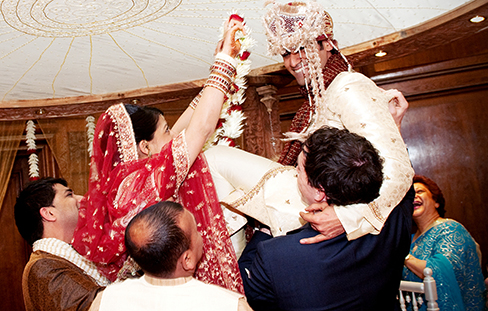
Figure 1. People tend to exist attracted to similar people. Many couples share a cultural background. This can be quite obvious in a ceremony such as a wedding, and more than subtle (but no less significant) in the twenty-four hours-to-day workings of a relationship. (credit: modification of work past Shiraz Chanawala)
But, homophily limits our exposure to diversity (McPherson et al., 2001). By forming relationships simply with people who are like to us, we will have homogenous groups and will non be exposed to dissimilar points of view. In other words, because we are probable to spend fourth dimension with those who are almost like ourselves, we will have express exposure to those who are unlike than ourselves, including people of unlike races, ethnicities, social-economic status, and life situations.
One time we class relationships with people, we desire reciprocity. Reciprocity is the give and take in relationships. We contribute to relationships, just we wait to receive benefits every bit well. That is, nosotros want our relationships to be a two way street. We are more likely to like and appoint with people who like us back. Self-disclosure is part of the 2 manner street. Self-disclosure is the sharing of personal data (Laurenceau, Barrett, & Pietromonaco, 1998). We grade more intimate connections with people with whom nosotros disclose important information about ourselves. Indeed, self-disclosure is a characteristic of good for you intimate relationships, every bit long as the information disclosed is consequent with our own views (Cozby, 1973).
Try Information technology
Attraction
Nosotros have discussed how proximity and similarity lead to the formation of relationships, and that reciprocity and self-disclosure are important for relationship maintenance. Just, what features of a person practice we notice bonny? We don't course relationships with anybody that lives or works near us, so how is it that we decide which specific individuals we will select as friends and lovers?
Researchers have documented several characteristics in men and women that humans detect attractive. First we expect for friends and lovers who are physically attractive. People differ in what they consider attractive, and attractiveness is culturally influenced. Research, however, suggests that some universally attractive features in women include big optics, high cheekbones, a narrow jaw line, a slender build (Kiss, 1989), and a lower waist-to-hip ratio (Singh, 1993). For men, attractive traits include being tall, having broad shoulders, and a narrow waist (Buss, 1989). Both men and women with high levels of facial and body symmetry are by and large considered more attractive than asymmetric individuals (Fink, Neave, Manning, & Grammer, 2006; Penton-Voak et al., 2001; Rikowski & Grammar, 1999). Social traits that people find attractive in potential female mates include warmth, affection, and social skills; in males, the attractive traits include achievement, leadership qualities, and job skills (Regan & Berscheid, 1997). Although humans desire mates who are physically attractive, this does not mean that we await for the most bonny person possible. In fact, this observation has led some to suggest what is known equally the matching hypothesis which asserts that people tend to pick someone they view as their equal in physical attractiveness and social desirability (Taylor, Fiore, Mendelsohn, & Cheshire, 2011). For instance, you and most people you know likely would say that a very bonny movie star is out of your league. So, fifty-fifty if you had proximity to that person, you likely would not inquire them out on a date considering you believe y'all likely would be rejected. People weigh a potential partner's attractiveness confronting the likelihood of success with that person. If you recall y'all are particularly unattractive (fifty-fifty if you are non), you likely will seek partners that are fairly unattractive (that is, unattractive in physical appearance or in behavior).
Link to Learning
Learn more than about attraction and dazzler at The Noba Project website.
Try Information technology
Sternberg's Triangular Theory of Love
We typically love the people with whom we class relationships, only the type of love we take for our family, friends, and lovers differs. Robert Sternberg (1986) proposed that there are three components of dearest: intimacy, passion, and commitment. These 3 components form a triangle that defines multiple types of love: this is known as Sternberg'southward triangular theory of love (Effigy ii). Intimacy is the sharing of details and intimate thoughts and emotions. Passion is the physical allure—the flame in the burn down. Delivery is continuing by the person—the "in sickness and health" office of the human relationship.

Effigy ii. According to Sternberg's triangular theory of dear, vii types of love can be described from combinations of three components: intimacy, passion, and commitment. (credit: modification of work by "Lnesa"/Wikimedia Commons)
Sternberg (1986) states that a healthy relationship volition have all 3 components of dear—intimacy, passion, and delivery—which is described as consummate dearest (Figure 3). All the same, different aspects of dear might exist more prevalent at different life stages. Other forms of dearest include liking, which is defined as having intimacy merely no passion or commitment. Infatuation is the presence of passion without intimacy or commitment. Empty beloved is having commitment without intimacy or passion. Companionate love, which is feature of close friendships and family relationships, consists of intimacy and commitment just no passion. Romantic love is defined by having passion and intimacy, but no commitment. Finally, fatuous love is divers by having passion and delivery, only no intimacy, such equally a long term sexual love thing. Can you lot draw other examples of relationships that fit these different types of honey?
Taking this theory a step further, anthropologist Helen Fisher explained that she scanned the brains (using fMRI) of people who had just fallen in love and observed that their brain chemical science was "going crazy," like to the encephalon of an addict on a drug loftier (Cohen, 2007). Specifically, serotonin production increased past every bit much every bit 40% in newly in-love individuals. Further, those newly in love tended to show obsessive-compulsive tendencies. Conversely, when a person experiences a breakup, the brain processes it in a similar way to quitting a heroin addiction (Fisher, Brownish, Aron, Strong, & Mashek, 2009). Thus, those who believe that breakups are physically painful are right! Another interesting point is that long-term love and sexual desire activate different areas of the brain. More than specifically, sexual needs activate the part of the encephalon that is peculiarly sensitive to innately pleasurable things such equally nutrient, sexual activity, and drugs (i.east., the striatum—a rather simplistic advantage system), whereas love requires conditioning—it is more like a addiction. When sexual needs are rewarded consistently, so dear can develop. In other words, love grows out of positive rewards, expectancies, and habit (Cacioppo, Bianchi-Demicheli, Hatfield & Rapson, 2012).
Link to Learning
Watch this TED talk by Helen Fisher to learn more almost the encephalon in dear.
Endeavor It

Figure three. According to Sternberg, consummate dear describes a healthy relationship containing intimacy, passion, and delivery. (credit: Kerry Ceszyk)
Social Substitution Theory
Nosotros have discussed why we form relationships, what attracts us to others, and different types of love. But what determines whether nosotros are satisfied with and stay in a human relationship? One theory that provides an explanation is social exchange theory. According to social exchange theory, we human activity as naïve economists in keeping a tally of the ratio of costs and benefits of forming and maintaining a relationship with others (Figure 4) (Rusbult & Van Lange, 2003).

Figure 4. Interim like naïve economists, people may keep rail of the costs and benefits of maintaining a human relationship. Typically, only those relationships in which the benefits outweigh the costs volition be maintained.
People are motivated to maximize the benefits of social exchanges, or relationships, and minimize the costs. People prefer to have more benefits than costs, or to take nigh equal costs and benefits, but most people are dissatisfied if their social exchanges create more costs than benefits. Let's hash out an case. If you have e'er decided to commit to a romantic relationship, you probably considered the advantages and disadvantages of your decision. What are the benefits of being in a committed romantic relationship? You may have considered having companionship, intimacy, and passion, but also being comfortable with a person you know well. What are the costs of being in a committed romantic relationship? You may think that over fourth dimension boredom from being with only one person may set in; moreover, it may be expensive to share activities such as attending movies and going to dinner. Still, the benefits of dating your romantic partner presumably outweigh the costs, or you wouldn't proceed the relationship.
Attempt It
Think It Over
- Retrieve about your recent friendships and romantic human relationship(s). What factors do yous think influenced the development of these relationships? What attracted you to becoming friends or romantic partners?
- Accept y'all ever used a social exchange theory approach to determine how satisfied you were in a relationship, either a friendship or romantic relationship? Have yous ever had the costs outweigh the benefits of a relationship? If so, how did you address this imbalance?
Relationships and Health
One of the greatest medicines in the world doesn't come up in pill form and it can't be injected with a syringe. No surgery is required. Information technology is other people.
An impressive amount of research from psychology and medicine supports the merits that having a strong social support network— supportive friends and family—is associated with maintaining both concrete and psychological health and recovering quickly and finer from concrete and psychological issues. Loneliness and isolation are risk-factors to leading a healthy, happy life.
The goal of scientific psychology is to sympathize the deep underlying causes of psychological and behavioral factors. Bear witness that there is an association betwixt health and social support is the kickoff—not the cease—of scientific investigation. We want to know why such a human relationship exists. This curiosity is non simply an academic exercise. Treatments tin simply be improved and targeted to specific needs if we understand how they work.
Correlations can identify interesting relationships (e.g., there is a positive correlation between a person's amount of social support and success in recovering from concrete and psychological problems), only they ordinarily cannot provide strong bear witness for why that human relationship exists. That is the job of experiments.
When you design an experiment, you must often create a very specific situation to test and explore your ideas. We have been talking in one thousand terms near "social support networks" and "mental and physical health," simply individual experiments typically cannot piece of work on such a broad scale. Instead, the experimenter tries to discover a single simple type of social support that can exist manipulated in the laboratory and a single simple chemical element of wellness that can be measured and studied in the laboratory. One disadvantage of this precipitous focus on a specific situation in experiments is that a single experiment—even a unmarried prepare of related experiments—is unlikely to fully identify the causes we are looking for. Experimental evidence typically accumulates slowly, over long periods of fourth dimension, filled with credible contradictions that can take fourth dimension and endeavor to sort out.

Figure 1. Does belongings a loved one'south hand decrease your experience of pain?
We are going to wait at 2 experiments from unlike research teams that take a similar approach to trying to empathise if social contact influences a health-related experience—in this case, hurting—and how such an influence might work (i.e., what might be the causal mechanisms?).
Experiment one: Love and Hurting
Sarah Fifty. Chief and her colleagues[one] conducted a simple experiment that they published in 2009. Their subjects were healthy college students who volunteered to participate in an experiment that tested the idea that contact with a romantic partner can reduce our experience of hurting.
PARTICIPANTS
Primary and her colleagues recruited heterosexual couples to participate in their study.[2] The women were the actual subjects in the written report. Their male partners participated as part of the experimental manipulation. The participants were in stable, long-term (defined here as longer than 6 months) relationships.
Hurting INDUCTION
Before the experiment began, each woman was tested to find her personal hurting experiences for thermal stimulation (i.east., heat), which was produced by a medical device called a thermode. Different people experience and written report pain very differently, then scale of the thermal stimulation to the private'south pain experience was essential. The thermal stimulation during the experiment was adapted to the point at which the subject reported a "moderate" level of discomfort (10 on a twenty-signal discomfort scale) when the heat was applied. This means that different people experienced different objective amounts of heat, while the subjective "discomfort" should take been approximately the aforementioned. The heat stimulus was delivered to the soft inside of the right forearm[3], and each one lasted for 6 seconds.
EXPERIMENTAL CONDITIONS
At that place were 7 weather in the experiment.
In three of the atmospheric condition, the adult female held something in her hand equally she experienced the painful thermal stimulation. She held either:
- The hand of her partner (who sabbatum behind a curtain, and—except for his hand—was not visible.
- The hand of a male person stranger (who was also behind a curtain).
- An object: a squeeze ball.
In three other atmospheric condition, the woman looked at a picture on a reckoner screen in front of her. She saw either:
- A picture of her partner taken while the woman was existence prepared for the experiment.
- A picture of a male stranger (similar age and matched for ethnicity with the adult female's partner).
- An object: a flick of a chair.
1 command (or baseline) condition:
- The woman looked at a fixation cross on the computer screen.
The figure beneath shows summarizes the organization (technically, the "design") of the experiment.

PROCEDURE
The woman received twelve thermal stimulations in each condition. The guild of presentation of conditions was randomized for each woman.[four] There was a twenty-2nd break between stimulations. Afterward each stimulation, the subject area rated how "uncomfortable" the stimulus was on a 21-point scale.
Effort It
A "condition" or "level" is a variation on something manipulated by the experimenter. An independent variable is fabricated up of variations. For some process to be an independent variable, information technology must have at least two conditions (otherwise information technology is a constant and not a variable).
RESULTS
The results in this study are non shown on the original 21-bespeak scale. To take business relationship of individual differences, the control status (i.e., looking at a fixation cross on a reckoner screen) the experimenters establish the difference between each person's average control status unpleasantness rating and her rating for each condition. For example, imagine that ane participant has the following average "unpleasantness" ratings (on the 21-betoken calibration):[five] 
The control rating (ten) is and then subtracted from each of the treatment ratings. This becomes the score that is analyzed (called a "difference score"). This method allows each adult female to have a unlike general pain level (in the example, information technology is "x" but another person might have "half-dozen" or "12" as her average). The difference score looks at each person'due south change from her personal baseline under the various conditions. Here are the departure scores for the example above:

For the difference scores, a positive number ways that the experience in that condition was more painful than information technology was in the control condition. A negative number means that the experience in that condition was less painful than it was in the control condition. The exact number used indicates how much more or less painful the experience was.
Earlier we show yous the actual results of the experiment, we'd like you to predict what you think happened in this experiment. Apply the figure below. The goose egg baseline is the control condition. Your predictions are nearly the vi handling weather. Yous tin can click and drag on a bar to move the bar up, if yous recall that condition was more painful for the subject field than the baseline control. And you tin can move a bar down if you think that status was less painful than the baseline command status.
Endeavour Information technology
The initial screen below shows all vi of the treatment conditions as a tiny chip more than painful than the baseline command. Brand your predictions based on your own theory about the possible positive or negative effects of holding the hands of a person y'all dear or of a stranger, or looking at a moving-picture show of a person yous dearest or a stranger while you are in hurting. Recollect that zero baseline control is still very painful, so zero does non mean that there is no pain.
Click Hither to see the actual results from the experiment.

Attempt It
Permit's use these results to rank the gild of the conditions in terms of their outcome on pain. Drag the condition proper name on the right into the appropriate box next to the rank order number on the left.
CONCLUSIONS
These results propose that there is something special about a person nosotros love—or at least someone we like. Dr. Master noted that looking at a moving picture of a loved one may be slightly more beneficial than holding his hand, though this difference did non quite attain statistical significance. Holding a stranger's mitt exaggerated the pain experience by a considerable amount, so it is clear that (in the context of this experiment) homo contact lone is not enough to relieve pain.
Dr. Chief brand a practical suggestion: If yous are going to have a painful medical procedure, bringing a flick of someone you love may be helpful in reducing the hurting. In fact, based on comparison of the hand property and flick viewing conditions, yous may actually be better off bringing a picture than bringing the actual person to the painful process.
Here is her final conclusion: "In sum, these findings claiming the notion that the beneficial effects of social support come solely from supportive social interactions and suggest that uncomplicated reminders of loved ones may exist sufficient to engender feelings of support." If you think dorsum to the introduction to this activity, we said that our goal was to detect out how and why social support leads to ameliorate health outcomes. Every bit nosotros cautioned you, this experiment doesn't fifty-fifty come shut to answering that question. All the same, it does accept united states one little stride in the right direction, suggesting that "social support" may be more complicated than just having people near us or fifty-fifty a grouping of friends. "Social support" may involve triggering certain cerebral (mental) processes, such as memories and emotions, that are associated with stiff positive relationships. That is for time to come enquiry to clarify.
Experiment 2: Reducing Pain in the Encephalon
A completely different group of researchers, led past Jarred Younger[6] at the Stanford University Schoolhouse of Medicine used fMRI (functional magnetic resonance imaging) to view the brains of people in an experiment very similar to the i you just studied. Just every bit in the previous study, they used heat to produce pain, though the location was at the base of operations of the thumb on the palm of the left paw. They used two levels of heat, which they labeled as "moderate" and "high". They only tested picture-viewing; there was no paw belongings in this study.
DETAILS OF THE EXPERIMENT
Younger and his colleagues tested both females and males by scanning their brains equally they looked at pictures of romantic partners or mere friends. At that place was also a command condition explained beneath.
Each person brought to the experiment several pictures of his or her romantic partner. Only participants who reported beingness "intensely in beloved" and who scored at a very high level on the Passionate Love Scale (a standardized measure of passionate love) were included in the study. The participants also brought some pictures of a friend or acquaintance of the aforementioned gender and bewitchery as the romantic partner. In the experiment, the participants used the aforementioned procedures that were used in the other study yous read. When looking at the picture, they were asked to focus on the movie and think about the person in the picture (romantic partner or friend).
For a third control or baseline condition, the experimenters wanted to see if looking at the flick was only a distraction from the hurting. In this distraction control condition, the participant was given a category name (e.1000., animals, fruits, actors, politicians) and was asked to say aloud as many examples of that category as possible (ANIMALS: canis familiaris, bear, salmon, eagle, etc.).
GOAL OF THE EXPERIMENT
The experimenters were interested in a very specific hypothesis. They wondered if thinking about someone we love intensely activates our brain's reward system. This is a group of structures deep in the heart of the brain surrounding some neural structures called the basal ganglia (see figure beneath). Amid their advantage-related activities is their production of the neurotransmitter dopamine, which they ship to regions throughout the brain. Dopamine is an of import part of the pleasure and learning experiences associated with rewarding activities.

Figure ii. The basal ganglia play an important role in producing dopamine in the brain.
Because they were interested in testing the idea that the reward system might be activated past viewing someone we passionately love, the experimenters focused their brain scanning on the advantage system areas shown above. However, they as well looked at other brain areas, so they could determine if the reward arrangement was more strongly associated with pain reduction than other areas.
RESULTS OF THE REWARD SYSTEM EXPERIMENT
By at present, yous should have the idea that things are seldom elementary in the earth of scientific discipline. Outset, the bones results from the first study y'all read about were plant here every bit well. Participants reported significantly less hurting when they looked at a flick of their romantic partner than when they looked at a stranger. Unfortunately (if you lot wanted simple results), most exactly the same reduction in hurting was institute in the distraction control condition.
The figure below shows the results. These researchers used an eleven-point pain scale (0=no pain, 10=worst pain imaginable), and then the numbers cannot be direct compared to those in the first study. Nonetheless, higher numbers hateful more than pain, and then the results can be understood easily.

Try It
These results solitary suggest that looking at pictures of someone we love may be zero more than a distraction from the pain. However, this experiment was unlike than the first one because it had another dimension: the brain scans. What did they indicate?
Brain IMAGING RESULTS
The encephalon images add together an interesting dimension to our understanding of pain and hurting relief. When participants were looking at pictures of their romantic partner, the reward regions of the brain were very active. In fact, in that location was a strong correlation between the amount of activity in this region and the level of hurting the person reported: more activeness was associated with less pain.

Figure 3. These cross-sections of the brain show the general areas where researchers were focused during the experiment. The figure on the left shows the brain region responding when the subject held her partner'due south hand. The figure on the right shows the regions of the brain activated when the subject was distracted.
If the reward systems (in the figure above, the red circle in the brain on the left) were also activated by the lark task, then we are dorsum to the idea that looking at our romantic partner is just a mode of distracting ourselves. But that is Non what they found. Activity in the reward regions of the brain were not strongly correlated with pain relief during the lark task. However, other regions of the brain did accept a strong relationship to hurting relief in the lark condition (see the blue circles on the encephalon to the right in the figure in a higher place). These are brain areas involved in memory, language, and making choices—exactly the systems that are active when we think near words that fit a particular category.
CONCLUSIONS
This report past Jarred Younger and his colleagues suggests that there may be multiple ways to reduce our experience of pain. The two approaches studied here (touching someone we love and generating words) may produce the similar analgesic furnishings: both result in less pain. Just in terms of underlying causal mechanisms, such every bit the encephalon systems involved in reducing pain, very different things may be taking place.
This is non the terminate of the story. Finding a brain region associated with some experience is not an caption; it is simply a offset stride in finding how a brain system works. Finding two sets of brain regions which both produce the same effect suggests that our explanation of how pain reduction is accomplished by the encephalon is not going to be elementary.
Finally, if you were hoping to find out if there were sex activity differences in the effects we discussed, unfortunately the experimenters felt they did not have enough subjects to reliably exam to run into if men and women differ in their response to pain or in the regions of the encephalon associated with pain reduction. Maybe one of you will acquit the experiment that answers those questions!
Full general Conclusions
We started this do with a give-and-take of social support and health. People with stronger social support networks tend to have amend health outcomes. When we asked how this works, we zoomed in on a very specific blazon of social support: a romantic relationship, which involve deep and complex connections between 2 people. Information technology would be reasonable to suggest that this type of relationship might have the potential to produce the strongest possible form of social support.
Both experiments showed that social back up in the form of touching someone nosotros dearest (or seeing a picture show of that person in the first experiment) can reduce pain, when compared to control conditions. The second experiment points to the brain'south reward system every bit a possible source of pain relief. We however don't know the brain machinery that produces the pain experience; it is possible that we fully feel the pain, simply the positive feelings associated with the person we love residuum out the negative experience of hurting. Or maybe the advantage system can actually turn downwards the intensity of the hurting experience, so we really experience less pain when we are with those nosotros love. The scientists of your generation volition have the opportunity to explore these mysteries.
Glossary
altruism:humans' desire to help others even if the costs outweigh the benefits of helping
companionate dearest:type of love consisting of intimacy and commitment, merely not passion; associated with close friendships and family unit relationships
consummate beloved:type of love occurring when intimacy, passion, and commitment are all present
empathy:capacity to empathise some other person's perspective—to feel what he or she feels
homophily:tendency for people to form social networks, including friendships, marriage, business organization relationships, and many other types of relationships, with others who are similar
mere-exposure effect: the more oftentimes we are exposed to a stimulus (e.grand., sound, person) the more likely nosotros are to view that stimulus positively
prosocial behavior:voluntary behavior with the intent to help other people
reciprocity:give and have in relationships
romantic love:blazon of dear consisting of intimacy and passion, merely no delivery
self-disclosure:sharing personal information in relationships
social exchange theory:humans act as naïve economists in keeping a tally of the ratio of costs and benefits of forming and maintain a relationship, with the goal to maximize benefits and minimize costs
triangular theory of love:model of love based on three components: intimacy, passion, and commitment; several types of love exist, depending on the presence or absenteeism of each of these components
Source: https://courses.lumenlearning.com/wmopen-psychology/chapter/prosocial-behavior/
0 Response to "whats the chances of someone you are attracted to attracted to you"
Post a Comment