What Characteristic of Egyptian Art Is Deomonstarted by the Funerary Temple of Queen Hatshepsut
| [a] | |
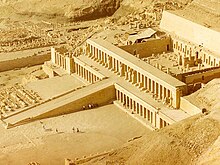 Hatshepsut's Temple | |
| Shown within Egypt | |
| Location | Upper Egypt |
|---|---|
| Region | Deir el-Bahari |
| Coordinates | 25°44′17.8″N 32°36′23.vii″E / 25.738278°Northward 32.606583°Eastward / 25.738278; 32.606583 Coordinates: 25°44′17.8″Due north 32°36′23.7″E / 25.738278°N 32.606583°Eastward / 25.738278; 32.606583 |
| Blazon | Mortuary temple |
| Length | 273.five yard (897 ft) (Temple)[2] one,000 m (3,300 ft) (Causeway)[3] |
| Width | 105 m (344 ft)[2] |
| Summit | 24.5 thousand (fourscore ft)[2] |
| History | |
| Builder | Unclear, possibly: Senenmut, Overseer of Works Hapuseneb, Loftier Priest |
| Textile | Limestone, sandstone, granite |
| Founded | c. 15th century BC |
| Periods | Late Bronze Age I |
| Cultures | Egyptian, Coptic |
| Site notes | |
| Excavation dates | 1827–present |
| Condition | Reconstructed |
| Public access | Limited |


The Temple of Hatshepsut (Egyptian: Ḏsr-ḏsrw significant "Holy of Holies") is a mortuary temple congenital during the reign of Pharaoh Hatshepsut of the Eighteenth Dynasty of Egypt.[b] Located opposite the urban center of Luxor, it is considered to be a masterpiece of ancient compages.[c] Its three massive terraces rise above the desert floor and into the cliffs of Deir el-Bahari. Her tomb, KV20, lies within the same massif capped by El Qurn, a pyramid for her mortuary circuitous. At the border of the desert, 1 km (0.62 mi) east, connected to the complex past a causeway lies the accompanying valley temple. Across the river Nile, the whole structure points towards the monumental 8th Pylon, Hatshepsut's most recognizable addition to the Temple of Karnak and the site from which the procession of the Cute Festival of the Valley departs. The temple's twin functions are identified by its axes: on its primary east-w centrality, it served to receive the barque of Amun-Re at the climax of the festival, while on its north-south centrality it represented the life cycle of the pharaoh from coronation to rebirth.
Construction of the terraced temple took place betwixt Hatshepsut'southward seventh and twentieth regnal year, during which building plans were repeatedly modified. In its design it was heavily influenced past the Temple of Mentuhotep II of the Eleventh Dynasty congenital 6 centuries earlier.[d] In the arrangement of its chambers and sanctuaries, though, the temple is wholly unique. The main axis, ordinarily reserved for the mortuary complex, is occupied instead past the sanctuary of the barque of Amun-Re, with the mortuary cult beingness displaced southward to form the auxiliary axis with the solar cult complex to the north. Separated from the principal sanctuary are shrines to Hathor and Anubis which lie on the middle terrace. The porticoes that front the terrace hither host the most notable reliefs of the temple. Those of the expedition to the Land of Punt and of the divine birth of Hatshepsut, the backbone of her case to rightfully occupy the throne every bit a fellow member of the royal family and equally godly progeny. Beneath, the lowest terrace leads to the causeway and out to the valley temple.
The land of the temple has suffered over fourth dimension. Two decades after Hatshepsut'south death, nether the direction of Thutmose III, references to her dominion were erased, usurped or obliterated. The campaign was intense but brief, quelled after two years when Amenhotep 2 was enthroned. The reasons behind the proscription remain a mystery. A personal grudge appears unlikely equally Thutmose III had waited twenty years to deed. Maybe the concept of a female male monarch was abomination to ancient Egyptian club or a dynastic dispute betwixt the Ahmosid and Thutmosid lineages needed resolving. In the Amarna Menstruation the temple was incurred upon over again when Akhenaten ordered the images of Egyptian gods, specially those of Amun, to be erased. These damages were repaired subsequently nether Tutankhamun, Horemheb and Ramesses II. An convulsion in the Tertiary Intermediate Period caused farther harm. During the Ptolemaic period the sanctuary of Amun was restructured and a new portico built at its archway. A Coptic monastery of Saint Phoibammon was built betwixt the 6th and 8th centuries Advertizing and images of Christ were painted over original reliefs. The latest graffito left is dated to c. 1223.
The temple resurfaces in the records of the modern era in 1737 with Richard Pococke, a British traveller, who visited the site. Several visitations followed, though serious excavation was not conducted until the 1850s and 60s under Auguste Mariette. The temple was fully excavated between 1893 and 1906 during an trek of the Egypt Exploration Fund (EEF) directed past Édouard Naville. Farther efforts were carried out by Herbert E. Winlock and the Metropolitan Museum of Fine art (MMA) from 1911 to 1936, and by Émile Baraize and the Egyptian Antiquities Service (at present the Supreme Quango of Antiquities (SCA)) from 1925 to 1952. Since 1961, the Polish Heart of Mediterranean Archeology (PCMA) has carried out extensive consolidation and restoration works throughout the temple.
Design [edit]

The temple of Hatshepsut at Deir el-Bahari

Temple plan: 1) entrance gate; 2) lower terrace; 3) lower porticoes; 4) ramps; 5) middle terrace; 6) middle porticoes; seven) n portico; viii) Hathor shrine; nine) Anubis shrine; 10) upper terrace; 11) festival courtyard; 12) Amun shrine; xiii) solar cult court; and 14) mortuary cult complex.
From her accession to the throne, Hatshepsut renewed the act of monument building.[17] The focal point of her attending was the city of Thebes and the god Amun, by whom she legitimized her reign.[ten] [18] [19] The preeminent residence of Amun was the Temple of Karnak[20] to which Hatshepsut had contributed the Eighth Pylon, two 30.v m (100 ft) alpine obelisks, offer chapels, a shrine with two further obelisks, and statues of herself.[10] [21] Facing Karnak from across the river Nile, she built a mortuary temple against the cliffs of Deir el-Bahari.[22] The tiptop of her architectural contributions,[22] it is considered to be among the bang-up architectural wonders of the aboriginal world.[9] [11]
At its far eastern end, lay a valley temple followed by a 1 km (0.62 mi) long, 37 m (121 ft) wide causeway, which also hosted a barque station at its midpoint, that led to the entrance gate of the mortuary temple.[3] [23] [24] Here, three massive terraces rose above the desert floor[24] and led into the Djeser-Djeseru or "Holy of Holies".[10] [25] Near the whole temple was built of limestone, with some red granite and sandstone.[26] A single architrave was built of violet sandstone, purportedly sourced from Mentuhotep II's temple.[27] This temple, built centuries earlier and found immediately south of Hatshepsut'south, served as the inspiration for her design.[28] On its main axis and at the end of temple, lay the temple'due south main cult site, a shrine to Amun-Re, which received his barque each year during the Cute Festival of the Valley in May.[29] [thirty] [31] In the south were the offering halls of Thutmose I and Hatshepsut and to the north was the solar cult courtroom.[32] Outside, two further shrines were built for Hathor and Anubis, respectively.[33] In total, the temple comprised five cult sites.[34]
The identity of the builder behind the projection remains unclear. It is possible that Senenmut, the Overseer of Works, or Hapuseneb, the High Priest, were responsible. It is also likely that Hatshepsut provided input to the projection.[10] Over the course of its construction, betwixt the seventh and twentieth year of Hatshepsut'southward reign, the temple plan underwent several revisions.[27] A clear example of these modifications is in the Hathor shrine, whose expansions included, among other things, a conversion from a single to dual hypostyle halls.[35] Its pattern was directly inspired by Mentuhotep Ii'due south adjoining temple immediately south,[thirteen] although its manner of arrangement is entirely unique.[eleven] For example, whilst the central shrine of Mentuhotep Ii's temple was defended to his mortuary cult, Hatshepsut instead elevated the shrine of Amun to greater prominence.[36] [22] However, her mortuary cult was otherwise afforded the near voluminous bedchamber in the temple, harkening back to the offer halls of the pyramid age.[36] At that place are parallels betwixt the temple'south architectural style and contemporaneous Minoan architecture, which has raised the possibility of an international style spreading beyond the Mediterranean in this period.[10] [37] Hatshepsut may also be of partly Cretan descent.[37] Overall, the temple is representative of New Kingdom funerary compages which served to laud the pharaoh and to honour gods relevant to the afterlife.[38]
Architecture [edit]
Terraces [edit]
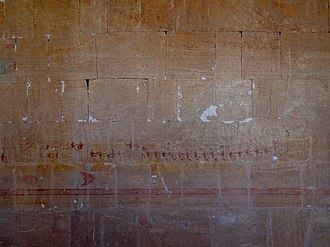
Hatshepsut's expedition to Punt
The opening feature of the temple is the iii terraces fronted past a portico leading upward to the temple proper, and arrived at by a 1 km (0.62 mi) long causeway that led from the valley temple.[27] Each elevated terrace was accessed past a ramp which bifurcated the porticoes.[xiii]
The lower terrace measures 120 m (390 ft) deep by 75 m (246 ft) wide and was enclosed past a wall with a single 2 one thousand (half dozen.six ft) wide entrance gate at the centre of its e side. This terrace featured 2 Persea (Mimusops schimperi) copse, ii T-shaped basins which held papyri and flowers, and two recumbent lion statues on the ramp balustrade.[39] [40] The 25 one thousand (82 ft) wide porticoes of the lower terrace comprise 22 columns each, arranged in 2 rows,[41] [42] and characteristic relief scenes on their walls.[24] [43] The south portico's reliefs depict the transportation of two obelisks from Elephantine to the Temple of Karnak in Thebes, where Hatshepsut is presenting the obelisks and the temple to the god Amun-Re. They also depict Dedwen, Lord of Nubia[43] and the 'Foundation Ritual'.[44] The north portico'southward reliefs depict Hatshepsut every bit a sphinx crushing her enemies, along with images of fishing and hunting, and offerings to the gods.[43] [45] The outer ends of the porticoes hosted 7.8 thou (26 ft) tall Osiride statues.[46] [47]
The middle terrace measures 75 grand (246 ft) deep past ninety m (300 ft) wide fronted by porticoes on the w and partially on the north sides.[45] [13] The west porticoes contain 22 columns arranged in ii rows while the north portico contains 15 columns in a single row.[41] The reliefs of the westward porticoes of this terrace are the most notable from the mortuary temple. The south-west portico depicts the expedition to the Land of Punt and the transportation of exotic appurtenances to Thebes. The northward-westward portico reliefs narrate the divine birth of Hatshepsut to Thutmose I, represented as Amun-Re, and Ahmose. Thus legitimizing her rule both by majestic lineage and godly progeny.[43] [45] This is the oldest known scene of its type.[48] Structure of the north portico and its four or 5 chapels was abandoned prior to completion and consequently it was left blank.[49] [l] The terrace as well probable featured sphinxes prepare forth the path to the next ramp,[45] whose balustrade was adorned by falcons resting upon coiled cobras.[51] In the s-west and northward-westward corner of the terrace are the shrines to Hathor and Ra, respectively.[43] [45] [41]
The upper terrace opens to 26 columns each fronted past a 5.two yard (17 ft) tall Osiride statue of Hatshepsut.[52] [13] They are split in the heart by a granite gate through which the festival courtyard was entered.[53] [54] This division is represented geographically, also, as the southern colossi carry the Hedjet of Upper Egypt, while the northern colossi bear the Pschent of Lower Egypt.[54] The portico here completes the narrative of the preceding porticoes with the coronation of Hatshepsut every bit king of Upper and Lower Egypt.[51] The courtyard is surrounded by pillars, ii rows deep on the due north, due east and s sides, and three rows deep on the westward side.[13] Eight smaller and ten larger niches were cut into the west wall, these are presumed to accept independent kneeling and continuing statues of Pharaoh Hatshepsut.[forty] [45] The remaining walls are carved with reliefs. The Beautiful Festival of the Valley on the north, the Festival of Opet on the east, and the coronation rituals on the south.[32] [45] Iii cult sites branch off from the courtyard.[32] The sanctuary of Amun lies west on the main axis, to the north was the solar cult court, and to the south was chapel dedicated to the mortuary cults of Hatshepsut and Thutmose I.[55] [41]
-
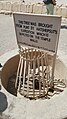
Remains of a Persea tree of the lower terrace
-

Balustrade adorned with a Horus statue
-
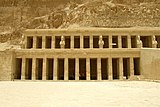
Punt portico of the middle terrace
-

Northward portico of the middle terrace
-

Osiride statues of Hatshepsut of the upper terrace
Hathor shrine [edit]
At the due south end of the middle terrace is a shrine defended to the goddess Hathor.[56] [43] [45] The shrine is separated from the temple and is accessed by a ramp from the lower terrace, although an alternative archway existed at the upper terrace.[47] [57] [45] The ramp opens up to a portico adorned with 4 columns carrying Hathor capitals.[56] [53] The walls of the entrance incorporate scenes of Hathor beingness fed by Hatshepsut.[58] Within are two hypostyle halls, the first containing 12 more than columns[53] and the second containing sixteen columns.[45] Beyond this are a vestibule containing two more columns and a double sanctuary.[45] Reliefs on the walls of the shrine depict Hathor with Hatshepsut, the goddess Weret-hekhau presenting the pharaoh with a Menat necklace, and Senenmut.[45] [53] Hathor holds special significance in Thebes, representing the hills of Deir el-Bahari, and as well to Hatshepsut who presented herself every bit a reincarnation of the goddess.[56] [43] Hathor is also associated with Punt, which is the subject of reliefs in the proximate portico.[43]
-

The shrine to Hathor
-

Entrance into the Hathor shrine
-

Hathor capital columns
Anubis shrine [edit]
At the north end of the middle terrace is a shrine dedicated to the god Anubis.[33] [43] [45] This shrine is smaller than its analogue to Hathor in the south.[43] [53] It comprises a hypostyle hall adorned with 12 columns bundled into three rows of four, followed by a sequence of two rooms terminating at a small niche.[45] [56] Images presented on the walls are of offerings and cult action, with a relief showing Anubis escorting Hatshepsut to the shrine.[45] The name of Anubis was used to designate the heir to the throne, which the Egyptologist Ann Macy Roth associates to the reliefs depicting Hatshepsut's divine birth.[43]
-
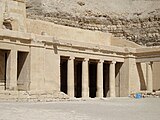
The shrine to Anubis
-

Anubis presented with bounteous offerings
-

Sokaris (Osiris) presented with wine by Thutmose Iii
Amun shrine [edit]
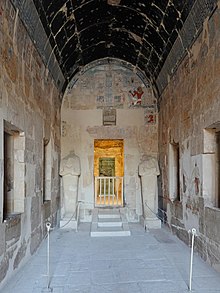
Barque hall of the shrine to Amun
Situated at the back of the temple, on its principal centrality, is the climactic point of the temple, the sanctuary of Amun, to whom Hatshepsut had dedicated the temple as 'a garden for my begetter Amun'.[34] [22] [59] Inside, the offset chamber was a chapel which hosted the barque of Amun and a skylight that allowed light to inundation onto the statue of Amun.[34] [60] The lintel of the red granite entrance depicts 2 Amuns seated upon a throne with backs together and kings kneeling in submission earlier them, a symbol of his supreme status in the sanctuary.[61] Inside the hall are scenes of offerings presented by Hatshepsut and Thutmose I, accompanied by Ahmose and Princesses Neferure and Nefrubity,[62] four Osiride statues of Hatshepsut in the corners,[63] and six statues of Amun occupying the niches of the hall.[61] In the tympanum, cartouches containing Hatshepsut'southward name are flanked and apotropaically guarded past those of Amun-Re.[64] This chamber was the end point of the annual Cute Festival of the Valley.[65]
The 2d chamber contained a cult image of Amun,[sixty] [34] [62] and was flanked either side by a chapel.[66] The north chapel was carved with reliefs depicting the gods of the Heliopolitan Ennead and the south chapel with the corresponding Theban Ennead. The enthroned gods each carried a was-sceptre and an ankh. Presiding over the delegations, Atum and Montu occupied the cease walls.[67] The third chamber contained a statue effectually which the 'Daily Ritual' was also performed. Information technology was originally believed to have been constructed a millennium afterward the original temple, under Ptolemy VIII Euergetes, giving it the name 'the Ptolemaic Sanctuary'. The discovery of reliefs depicting Hatshepsut bear witness the structure to her reign instead.[68] The Egyptologist Dieter Arnold speculates that information technology might accept hosted a granite simulated door.[34]
Solar cult courtroom [edit]

Chantry of the solar cult circuitous
The solar cult is accessed from the courtyard through a entrance hall occupied past three columns in the n side of the upper terrace courtyard.[45] [56] The doorjamb of the archway is embellished with the figures of Hatshepsut, Ra-Horakhty (Horus) and Amun.[62] The reliefs in the foyer incorporate images of Thutmose I and Thutmose III.[32] The antechamber opens up to the master court which hosts a one thousand altar open to the sky and accessed from a staircase in the court'south west.[56] [45] [58] There are two niches nowadays in the court in the south and due west wall, the old shows Ra-Horakhty presenting an ankh to Hatshepsut and the latter contains a relief of Hatshepsut as a priest of her own cult.[45] Attached to the court was a chapel[due east] which contained representations of Hatshepsut's family unit.[xxx] In these, Thutmose I and his female parent, Seniseneb, are depicted giving offerings to Anubis, while Hatshepsut and Ahmose are depicted giving offerings to Amun-Re.[32]
Mortuary cult complex [edit]
Situated in the s of the courtyard was the mortuary cult complex.[36] Accessed through a vestibule adorned with 3 columns are two offer halls oriented on an eastward–due west axis.[70] [32] The northern hall is dedicated to Thutmose I; the southern hall is dedicated to Hatshepsut.[lxx] Hatshepsut's offering-hall emulated those plant in the mortuary temples of the Old and Center Kingdom pyramid complexes. Information technology measured 13.25 thou (43.5 ft) deep by 5.25 m (17.two ft) wide and had an vaulted ceiling six.35 m (twenty.8 ft) loftier.[36] Consequently, it was the largest chamber in the whole temple.[71] Thutmose I's offering-hall was decided smaller, measuring 5.36 m (17.6 ft) deep past 2.65 grand (eight.seven ft) broad.[72] Both halls contained red granite false doors, scenes of animal-sacrifice, offerings and offer-bearers, priests performing rituals, and the owner of the chapel seated before a table receiving those offerings.[32] Scenes from the offering-hall are direct copies of those present in the Pyramid of Pepi II, from the terminate of the Sixth Dynasty.[71]
Foundation deposits [edit]
Prior to its construction, the 'stretching of the string' otherwise known as the 'foundation ritual' was performed.[73] [44] The ritual is depicted in detail on the southward portico of the lower terrace. The ceremony opens before the goddess Seshat, it follows Hatshepsut and her ka scattering besen grains before she offers her temple to Amun-Re. The side by side scene has been lost, it preceded the endmost scene of the 'Great Offer' to Amun-Re-Kamutef.[44] [74] During the ceremony, the consecration of foundation deposits would accept place,[44] a exercise that started equally early as the Tertiary Dynasty of Egypt at the Pyramid of Djoser.[73] There are xvi known foundation deposits at Hatshepsut'south temple, that more often than not outline its perimeter, and a further iii at the valley temple.[75] Broadly, pottery, votives, food and ritual offerings, tools, scarabs and seal amulets were deposited into the prepared holes.[73] [76] The titles of Hatshepsut, Thutmose 3, and Neferure are incised into some of these items, equally are images and names of gods.[73]
-

Travertine vases[f] and lids[g] retrieved from a foundation deposit
-

Scarab bearing the inscription Mꜣꜥt-kꜣ-rꜥ nb tꜣwy significant Lord of the Two Lands, Maatkare
-

Delicately inscribed hammering stone,[h] knot amulet,[i] and msḫtyw adze[j]
Role [edit]
Mortuary complex [edit]
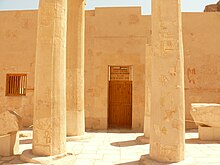
Entrance to the mortuary cult complex flanked past columns and the coronation ritual
It has been suggested that Hatshepsut's tomb in the Valley of the Kings, KV20, was meant to be an chemical element of the mortuary complex at Deir el-Bahari.[80] The arrangement of the temple and tomb bear a spatial resemblance to the pyramid complexes of the Old Kingdom,[81] [82] which comprised 5 central elements: valley temple, causeway, mortuary temple, master pyramid, and cult pyramid.[83] [84] Hatshepsut'southward temple complex included the valley temple, causeway, and mortuary temple. Her tomb was built into the massif of the same cliffs as the temple, beneath the dominating peak of El Qurn (489 grand (1,604 ft) AMSL[11]) that caps her tomb, in a sense, similar the pyramid capped the tomb of an Quondam Kingdom pharaoh.[85] Further, her tomb lies in-line with the offering hall of the mortuary cult circuitous.[86] There is some other coordinating relationship, that between the mortuary temple and Karnak and that of the pyramids and Heliopolis.[87] Though KV20 is recognized as the tomb of Hatshepsut, at that place is dispute over who commissioned its initial construction. 2 competing hypotheses advise that the tomb was built originally during the reign of either Thutmose I or Thutmose Two and that Hatshepsut had the tomb altered afterward with an additional sleeping accommodation for her own burial.[80]
The primary role of the temple was to serve the royal mortuary cults of Hatshepsut and Thutmose I.[22] [34] To fulfill this purpose, a mortuary cult complex was built where offerings could be fabricated for the kꜣ, or spirit, of the male monarch.[34] In the Egyptian formulation, the deceased continued to rely on the aforementioned sustenance equally the living. In life, the aspects of the soul, the kꜣ, bꜣ and ꜣḫ, were contained in the vessel of the living body. On death, the body was rendered immobile and the soul was able to leave it.[88] In her temple, the offering of food and drink was performed before the granite false doors of the offer chapels.[89] [90] [32] The mortuary ritual, lists of offerings, and the recipient of the rites were depicted on the east wall of both chapels.[32]
Cute Festival of the Valley [edit]

A section of the Cute Festival of the Valley relief
The sanctuary of Amun was the end point of the Beautiful Festival of the Valley, conducted annually, starting at the Temple of Karnak.[65] This celebration dated back to the Middle Kingdom, when it ended at the temple built by Mentuhotep 2.[91] [21] The procession began at the Eighth Pylon at Karnak led past Hatshepsut and Thutmosis III, followed by noblemen and priests bearing Amun'due south barque, accompanied past musicians, dancers, courtiers and more priests, and guarded by soldiers.[22] [91] A further flotilla of pocket-sized boats and the cracking ship Userhat, which carried the barque, were towed.[91] In Hatshepsut's time, the barque of Amun was a miniaturized copy of a transport clomp equipped with 3 long carrying-poles borne by vi priests each.[92] The figure of a ram's head, sacred to Amun, adorned its prow and stern.[92] [93] In the centre of its hull a lavishly ornamented naos was installed and the statue of Amun, presently bejewelled, cloistered within. The barque likely measured 4.v m (15 ft) in length.[92] The procession crossed the Nile, visited the cemeteries in remembrance, before landing at the valley temple to proceed along the 1 km (0.62 mi) long causeway to the temple proper.[22] [34] Halfway up was the barque station, beyond which the path was flanked by more than than 100 sandstone sphinxes upwardly to the terraces.[34] [27] This is the oldest attested sphinx avenue, though the practise is thought to date to the Sometime Kingdom.[94] The valley temple and barque station were points at which offerings were made and purification rituals conducted.[91] The procession carried on through the entrance-gate, up the temple'southward great ramps, and into the sanctuary where the barque and Amun were kept for a nighttime before being returned home to Karnak.[91] On this twenty-four hour period, bounteous offerings of nutrient, meat, potable and flowers were presented on tables to Amun, with smaller quantities reserved for the king.[95] On all other days, priests performed the 'Daily Ritual' upon the statues of Amun and Hatshepsut.[96]
Daily ritual [edit]
Before dawn each morn, a pair of priests visited the temple's well to collect h2o for transfer to libation vessels. Other priests busied themselves preparing food and potable every bit offerings to the gods while the head priest, ḥm-nṯr, visited the pr–dwꜣt to be purified and clothed in preparation for the ceremony. The naos containing the cult image of Amun-Re was first purified with incense. At kickoff lite, the head priest opened the shrine and prostrated himself earlier the god declaring that he had been sent on behalf of the male monarch, while other priests performed recitations. The shrine was purified with water and incense and a statuette of Maat was presented to the cult prototype which was and so removed. The statuette was de-clothed, cleared of oil, and placed on a pile of clean sand, a representation of benben. Fresh paint was practical to its optics, information technology was anointed with various oils, dressed in new garments of fabric, and provided with accessories. Lastly, its face was anointed and sand scattered around the chapel before the image was returned to its resting place. By now, the god's breakfast offering was presented to him. A terminal set up of purifications were conducted and the doors to shrine closed with the caput priest sweeping away his footsteps behind him. The food was taken away every bit well – they were not physically consumed, the god just partook of their essence – to be re-presented at the chapels of other deities. Each god received essentially the same service. The food was eventually consumed by the priests in the 'reversion of offerings', wḏb ḫt. More than purifying libations were poured and incense burned at the shrines at noon and in the evening. At other times, hymns were sung, apotropaic rituals performed to protect Amun-Re'due south barque as it voyaged across the sky, and wax or clay images of enemies destroyed.[97] [98]
After history [edit]
In aboriginal Egypt [edit]
Proscription of Hatshepsut by Thutmose III [edit]
2 decades after her death, during Thutmose III'southward forty-2nd regnal year, he decided that all evidence of her reign as king of Egypt should exist erased. His reasons for proscribing her reign remain unclear. This set on against her reign was, however, short-lived. Two years later on it started, when Amenhotep Two ascended to the throne, the proscription was abandoned and much of the erasure left half-finished.[99]
In that location are 3 hypotheses regarding Thutmose III's motivation. The oldest and most dubious is personal revenge. This hypothesis holds that Hatshepsut usurped the throne as sole ruler, relegating Thutmose Three, and consequently he sought to erase her memory. This explanation is unconvincing as the proscription was delayed by two decades and targeted but confronting her reign as king.[100] [101] The second argument is that it was a repudiation of the concept of female kingship. The role of a king was closed to women, and her assumption of the role may accept presented ideological problems that were resolved via erasure. This may explain the conclusion to leave images of her as queen intact.[102] [103] The third case assesses the possibility of a dynastic dispute between the Ahmosid and Thutmosid lineages. By expunging her rule from the record, Thutmose III may have ensured that his son, Amenhotep II, would arise the throne.[101] In that location is, withal, no known Ahmosid pretender.[102]
Several methods of erasure were employed at her temple by Thutmose III in his campaign. The to the lowest degree dissentious were the scratching out of feminine pronouns and suffixes, which otherwise left the text intact. These were commonly used in the Hathor shrine and in the upper terrace. More thorough removal methods included chiselling away, roughening, smoothing, patching or covering over of her image and titles. In other places her image was replaced with that of an offering tabular array. Occasionally, her paradigm was repurposed for a fellow member of the Thutmosid family. This was most oft Thutmose 2, although infrequently instead her cartouche was replaced with that of Thutmose I or Iii.[104] The final method, and the well-nigh destructive, was the obliteration of her statuary in the temple. Workmen dragged the statues from her temple to i of ii designated sites, a quarry – a burrow from which fill material was obtained – and the Hatshepsut Hole. Here, sledgehammers and stone blocks were used to break upwardly the statues which were then dumped into the chosen repositories.[105]
-

Statues of Hatshepsut were targeted for devastation during the proscription
-

The decapitated head from a Hatshepsut statue
-

Erasure of Hatshepsut'southward royal titulary (left)[chiliad] with Thutmose Iii'southward majestic titulary (right)[l]
-

A column re-inscribed with ꜥꜣ-ḫpr-northward-rꜥ, Thutmose II'due south throne name
-

A cleaved column with a partial serekh begetting the signs for Rꜥ and mrỉ
Amarna Flow to Third Intermediate Flow [edit]
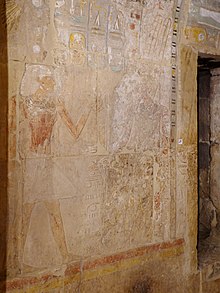
Erasure of Amun (right figure) by order of Akhenaten
The temple connected to serve every bit a site of worship following Thutmose Iii'due south death. During the Amarna Flow, farther erasure of the reliefs was inflicted by lodge of Akhenaten, albeit the target of this persecution were images of the gods, peculiarly Amun.[107] Early in his reign, Aten, a solar deity, was elevated to the condition of supreme god.[108] [109] The persecution of other gods did non brainstorm immediately, instead reform proceeded gradually for several years before culminating in prohibition around his ninth regnal year. The proscription coincides with the ostracization of Horus.[110] [111] These images were restored during the reigns of Tutankhamun, Horemheb, and Ramesses Two.[112] [92] The temple was damaged farther past an earthquake in the 9th century BC, during the 3rd Intermediate Menses.[107] [113] During this time, between the Xx-First and Xx-5th Dynasties, the temple was used as a burial ground for priests of the cults of Amun and Montu, equally well as for members of the imperial family.[114]
Ptolemaic era [edit]
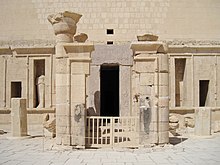
Ptolemaic portico of the festival courtyard
During the reign of Ptolemy III Euergetes, a stone chapel was built on the middle terrace for Asklepios, a god of the Greek pantheon.[107] [27] Later under Ptolemy VIII Euergetes, the sanctuary of Amun was significantly altered. The cult statue chamber was converted into a chapel for Amenhotep, son of Hapu, the Eighteenth Dynasty architect of Amenhotep III, Imhotep, the Third Dynasty vizier of Djoser, and Hygieia, the Greek goddess of hygiene.[115] [107] In the barque hall, the two centre niches were filled and the skylight blocked.[115] [63] The sanctuary archway was outfitted with a portico carried past 6 columns.[63] [107]
Across ancient Arab republic of egypt [edit]
After the Ptolemaic kingdom, the temple was used equally a site of local worship. Between the 6th and 8th centuries AD, a Coptic monastery of Saint Phoibammon was constructed on the temple grounds. Figures of Christ and other saints were painted over the original relief piece of work with the temple. A pilgrim left the latest dated graffito in c. 1223.[116]
Archaeological excavations [edit]
The earliest mod visitor to the temple was Richard Pococke, an English traveller, in 1737. He was followed by François Jollois and Renée Edouard Devilliers, two members of Napoleon Bonaparte's expedition, in 1798. The earliest archaeological findings were made around 1817 by Giovanni Battista Belzoni and Henry William Beechey, who scavenged the site for artefacts to nowadays to Henry Salt, the British consul. Another visitor to the site, in 1823–1825, Henry Westcar is credited with the earliest printed reference to the name Deir el-Bahari. In the following decades John Gardner Wilkinson, Jean-François Champollion and Karl Richard Lepsius each visited the site. The primeval significant excavations took identify in the 1850s and 60s under Auguste Mariette. Nether his supervision the remains of the monastery Saint Phoibammon were destroyed and the shrines to Hathor and Anubis too every bit the south colonnade of the middle terrace were revealed. During the Arab republic of egypt Exploration Fund'south (EEF) expedition, nether Édouard Naville and his assistant Howard Carter, from 1893–1906, the entire temple was excavated. The seven volumes of Naville's work form a central source for the temple. In 1911–1936, the Metropolitan Museum of Art (MMA) funded earthworks works under the management of Herbert Eastward. Winlock. In 1925–1952, a squad led by Émile Baraize for the Egyptian Antiquities Service reconstructed significant portions of the temple. Since 1961, the Polish Heart of Mediterranean Archaeology (PCMA) of Warsaw University in Cairo has been engaged in restoration and consolidation efforts at the site.[117] [27]
The Smoothen-Egyptian Archaeological and Conservation Trek was established past Kazimierz Michałowski, after he was approached by the Supreme Quango of Antiquities (SCA). The project was originally constrained to reconstructing the tertiary terrace, just, since 1967, the mission has encapsulated the entire temple. The projection is soon directed past Patryk Chudzik. The site is being gradually opened to tourism. Since 2000, the festival courtyard, upper terrace, and the coronation portico have been open to visitors. In 2015, the solar cult court and, in 2017, the sanctuary of Amun were also opened to visitation. [118] [119]

Panoramic view of the mortuary temple
See also [edit]
- List of ancient Egyptian sites
Notes [edit]
- ^ This is one of many recorded renderings of Ḏsr-ḏsrw. This detail rendering appears in the Hathor and Amun shrines.[ane]
- ^ Proposed dates for Hatshepsut's reign: c. 1502–1482 BC,[4] c. 1498–1483 BC,[5] c. 1479–1458 BC,[6] c. 1473–1458 BC,[7] c. 1472–1457 BC.[8]
- ^ An introduction by the Egyptologists and curators at the Metropolitan Museum of Fine art in New York Catherine H. Roehrig, Renée Dreyfus, and Cathleen A. Keller: 'During this period Egyptian artists reinterpreted the traditional forms of fine art and compages with an originality that is exemplified in Hatshepsut's temple at Deir el-Bahri in western Thebes, one of the great architectural wonders of the ancient world'.[nine] A statement past the archeologist Dieter Arnold: 'A masterpiece of pharaonic temple architecture and indeed of architecture world wide, the building was certainly designed by one of the greatest temple builders of aboriginal Arab republic of egypt'.[ten] A commentary by Zbigniew Szafrański, former director of the Smoothen Archaeological and Conservation Expedition at the Temple of Hatshepsut at Deir el-Bahari: 'An explosion of artistic inventiveness by Hatshepsut is exemplified in her temple at Deir el-Bahari. Mural, terraced architecture and sculpture created one of the great architectural wonders of the ancient globe. It is a masterpiece of pharaonic temple architecture'.[eleven]
- ^ Proposed dates for Mentuhotep II's reign: c. 2066–2014 BC,[12] c. 2051–2000 BC,[13] c. 2055–2004 BC,[14] c. 2010–1998 BC,[xv] c. 1897–1887 BC.[16]
- ^ Information technology is variously referred to as the 'upper Anubis shrine', 'chapel of the parents' and 'chapel of Thutmose I'.[69]
- ^ Tall vase bears sꜥt-rꜥ ẖnmt-ỉmn-ḥꜣt-špśwt ỉr due north southward mnnw s n tf southward ỉmn ḫft pḏ-šśḥr ḏsr-ḏsrw-ỉmn ỉr s ꜥnḫ-tỉ translating to 'daughter of Re Khnemet-Imen-Hatshepsut made her monument for her father at the time of the stretching of the cord over Djeser-djeseru-Amun so that she may exist made to live'. Small vase bears nṯrt nfr nbt tꜣwy Mꜣꜥt-kꜣ-rꜥ ꜥnḫ-tỉ * ỉmn g ḏsr-ḏsr-w mrỉt translating to 'the practiced goddess, lady of the Two lands, Maatkare, may she be made to live * beloved of Amun in Djeser-djeseru. See also Catherine H. Roehrig's translations on pp. 144–145.[77]
- ^ Large chapeau bears nṯrt nfr Mꜣꜥt-kꜣ-rꜥ ỉr n s mnnw s north tf due south ỉmn ḫft pḏ-šśḥr ḏsr-ḏsrw-ỉmn ỉr southward ꜥnḫ-tỉ rꜥ mỉ ḏet translating to 'the practiced goddess Maatkare, she made her monument for her male parent Amun at the time of the stretching of the cord over Djeser-djeseru-Amun and then that she may exist fabricated to live like Re forever'. Modest chapeau bears two columns of text facing each other reading nṯrt nfr Mꜣꜥt-kꜣ-rꜥ ꜥnḫ-tỉ * ỉmn ḥr-tp tꜣwy mrỉt translating to 'the good goddess Maatkare, may she exist made to alive' * 'honey of Amun, on behalf of the Two Lands'.
- ^ Begetting the inscription nṯrt nfr Mꜣꜥt-kꜣ-rꜥ ỉr due north s mnnw s n tf s ỉmn-rꜥ ḫft pḏ-šśḥr ḏsr-ḏsrw-ỉmn ỉr s ꜥnḫ-tỉ translating to 'the good goddess Maatkare, she made her temple for her father Amun-Re at the time of the stretching of the cord over Djeser-djeseru-Amun so that she may exist made to live'. See likewise Catherine H. Roehrig's translation on p.145.[78]
- ^ Bears her prenomen Mꜣꜥt-kꜣ-rꜥ to a higher place and nomen ẖnmt-ỉmn-ḥꜣt-špswt below.[79]
- ^ Bears her prenomen Mꜣꜥt-kꜣ-rꜥ.[79]
- ^ The left half of the relief was in one case occupied by the Horus, throne, and nativity names of Hatshepsut. The tiptop line has been thoroughly obliterated. Of the eye line, the shapes of nsw-bỉty remain but the cartouche does non. Behind it the text reads ỉmn-rꜥ mrỉ, meaning 'Beloved of Amun-Re'. This text appears on the opposite side of the same line as well. Of the lower line, the glyphs of sꜥ-rꜥ are legible, forth with ỉmn, a fragment of ẖnmt-ỉmn-ḥꜣt-špswt.[79]
- ^ The names read: i) Horus: Kꜣ-nḫt-ḫꜥ-grand-wꜣst ; 2) Throne: Mn-ḫpr-rꜥ ; iii) Birth: Ḏḥwty-ms nfr-ḫpr [106]
Citations [edit]
- ^ Iwaszczuk 2016, pp. 230–236.
- ^ a b c Iwaszczuk 2016, p. 49.
- ^ a b Pirelli 1999, pp. 275–276.
- ^ Troy 2001, p. 527.
- ^ Clayton 1994, p. 104.
- ^ Roehrig, Dreyfus & Keller 2005, p. 6.
- ^ Shaw 2003, p. 485.
- ^ Dodson & Hilton 2004, p. 290.
- ^ a b Roehrig, Dreyfus & Keller 2005, p. 4.
- ^ a b c d due east f Arnold 2005a, p. 135.
- ^ a b c d Szafrański 2014, p. 125.
- ^ Dodson & Hilton 2004, p. 289.
- ^ a b c d e f Arnold 2005a, p. 136.
- ^ Shaw 2003, p. 483.
- ^ Clayton 1994, p. 72.
- ^ Redford 2001, pp. 621–622.
- ^ Bryan 2003, pp. 231–232.
- ^ Grimal 1992, p. 209.
- ^ Roehrig, Dreyfus & Keller 2005, p. 3.
- ^ Allen 2005, p. 83.
- ^ a b Allen 2005, p. 84.
- ^ a b c d eastward f g Roth 2005, p. 147.
- ^ Arnold 2003, p. 104.
- ^ a b c Wilkinson 2000, p. 176.
- ^ Pirelli 1999, p. 275.
- ^ Iwaszczuk 2016, p. 10.
- ^ a b c d e f Pirelli 1999, p. 276.
- ^ Bryan 2003, p. 232.
- ^ Roth 2005, pp. 147 & 150.
- ^ a b Wilkinson 2000, p. 178.
- ^ Allen 2005, pp. 83–84.
- ^ a b c d eastward f one thousand h i Roth 2005, p. 150.
- ^ a b Arnold 2005a, pp. 138–139.
- ^ a b c d due east f chiliad h i Arnold 2005a, p. 137.
- ^ Iwaszczuk 2016, pp. eighty–85.
- ^ a b c d Arnold 2005a, p. 138.
- ^ a b Szafrański 2014, p. 126.
- ^ Strudwick & Strudwick 1999, p. 81.
- ^ Pirelli 1999, p. 277.
- ^ a b Arnold 2003, p. 105.
- ^ a b c d Arnold 2005a, p. 136, fig 57.
- ^ Pirelli 1999, p. 277, fig 24.
- ^ a b c d e f g h i j one thousand Roth 2005, p. 149.
- ^ a b c d Iwaszczuk 2016, p. 51.
- ^ a b c d e f g h i j k l m n o p q r Pirelli 1999, p. 278.
- ^ Szafrański 2018, pp. 377 & 390.
- ^ a b Grimal 1992, p. 211.
- ^ Yurco 1999, p. 819.
- ^ Ćwiek 2014, p. 82.
- ^ Iwaszczuk 2016, pp. 77–78.
- ^ a b Szafrański 2007, p. 95.
- ^ Szafrański 2018, p. 377.
- ^ a b c d e Wilkinson 2000, p. 177.
- ^ a b Szafrański 2014, p. 130.
- ^ Wilkinson 2000, pp. 177–178.
- ^ a b c d e f Arnold 2005a, p. 139.
- ^ Arnold 2005a, pp. 139, 137 figure 57.
- ^ a b Bryan 2003, p. 233.
- ^ Wilkinson 2000, pp. 176 & 178.
- ^ a b Pawlicki 2017, p. 28.
- ^ a b Pawlicki 2017, p. viii.
- ^ a b c Pirelli 1999, p. 279.
- ^ a b c Szafrański 2007, p. 97.
- ^ Pawlicki 2017, p. 4.
- ^ a b Roth 2005, pp. 147–148.
- ^ Pawlicki 2017, pp. 4 & 24.
- ^ Pawlicki 2017, p. 24.
- ^ Pawlicki 2017, p. 26.
- ^ Iwaszczuk 2016, p. 119.
- ^ a b Pirelli 1999, pp. 278–279.
- ^ a b Szafrański 2007, p. 98.
- ^ Iwaszczuk 2016, p. 115.
- ^ a b c d Roehrig 2005a, p. 141.
- ^ Karkowski 2016, p. 113.
- ^ Iwaszczuk 2016, pp. 51–52.
- ^ Iwaszczuk 2016, pp. 51–54.
- ^ Roehrig 2005a, pp. 144–145.
- ^ Roehrig 2005a, p. 145.
- ^ a b c Leprohon 2013, p. 98.
- ^ a b Roehrig 2005b, p. 185.
- ^ Ćwiek 2014, p. 67.
- ^ Iwaszczuk 2016, p. 50.
- ^ Bárta 2005, p. 178.
- ^ Verner 2001, pp. 47–54.
- ^ Ćwiek 2014, pp. 67–68.
- ^ Ćwiek 2014, p. 68.
- ^ Ćwiek 2014, p. 69.
- ^ Muller 2002, pp. 1–2.
- ^ Iwaszczuk 2016, p. 132.
- ^ Muller 2002, p. 2.
- ^ a b c d due east Pawlicki 2017, p. 10.
- ^ a b c d Pawlicki 2017, p. 12.
- ^ Hart 2005, p. 13.
- ^ Kasprzycka 2019, p. 361.
- ^ Pawlicki 2017, p. 16.
- ^ Pawlicki 2017, p. 14.
- ^ Thompson 2002, pp. 64–66.
- ^ Teeter 2001, pp. 341–342.
- ^ Dorman 2005, pp. 267–269.
- ^ Dorman 2005, pp. 267.
- ^ a b Roth 2005b, p. 281.
- ^ a b Dorman 2005, p. 269.
- ^ Robins 1993, pp. 51–52, 55.
- ^ Roth 2005b, pp. 277–279.
- ^ Arnold 2005b, pp. 273–274.
- ^ Leprohon 2013, pp. 99–100.
- ^ a b c d eastward Arnold 2005c, p. 290.
- ^ Hart 2005, pp. 34 & 36.
- ^ Grimal 1992, p. 227.
- ^ van Dijk 2003, pp. 269–270.
- ^ Schlögel 2001, pp. 156–158.
- ^ Szafrański 2007, p. 94.
- ^ Szafrański 2018, p. 385.
- ^ Szafrański 2007, pp. 98–99.
- ^ a b Pawlicki 2017, pp. 5–vi.
- ^ Arnold 2005c, pp. 290–291.
- ^ Arnold 2005c, pp. 291–293.
- ^ Szymczak 2019.
- ^ Pawlicki 2007, 1960.
Sources [edit]
- Allen, James P. (2005). "The Role of Amun". In Roehrig, Catharine (ed.). Hatshepsut From Queen to Pharaoh. New York: Metropolitan Museum of Art. pp. 83–85. ISBNane-58839-173-half dozen.
- Arnold, Dieter (2003). The Encyclopaedia of Ancient Egyptian Compages. London: I.B. Tauris. ISBN978-i-86064-465-eight.
- Arnold, Dieter (2005a). "The Temple of Hatshepsut at Deir el-Bahri". In Roehrig, Catharine (ed.). Hatshepsut From Queen to Pharaoh. New York: Metropolitan Museum of Fine art. pp. 135–140. ISBN1-58839-173-half-dozen.
- Arnold, Dorothea (2005b). "The Destruction of the Statues of Hatshepsut from Deir el-Bahri". In Roehrig, Catharine (ed.). Hatshepsut From Queen to Pharaoh. New York: Metropolitan Museum of Art. pp. 270–276. ISBNone-58839-173-six.
- Arnold, Dorothea (2005c). "A Chronology: The Later on History and Excavations of the Temple of Hatshepsut at Deir el-Bahri". In Roehrig, Catharine (ed.). Hatshepsut From Queen to Pharaoh. New York: Metropolitan Museum of Art. pp. 290–293. ISBN1-58839-173-half dozen.
- Bárta, Miroslav (2005). "Location of the Old Kingdom Pyramids in Egypt". Cambridge Archaeological Journal. 15 (2): 177–191. doi:x.1017/s0959774305000090.
- Bryan, Betsy M. (2003). "The 18th Dynasty before the Amarna Menstruum (c. 1550–1352 BC)". In Shaw, Ian (ed.). The Oxford History of Ancient Egypt. Oxford: Oxford University Printing. pp. 207–264. ISBN978-0-19-815034-iii.
- Clayton, Peter A. (1994). Chronicle of the Pharaohs. London: Thames & Hudson. ISBN978-0-500-05074-3.
- Ćwiek, Andrzej (2014). "Old and Middle Kingdom Tradition in the Temple of Hatshepsut at Deir el-Bahari". Études et Travaux. Instytut Kultur Śródziemnomorskich i Orientalnych. 27: 62–93. ISSN 2449-9579.
- Dodson, Aidan; Hilton, Dyan (2004). The Complete Royal Families of Ancient Egypt. London: Thames & Hudson. ISBN0-500-05128-3.
- Dorman, Peter (2005). "The Proscription of Hatshepsut". In Roehrig, Catharine (ed.). Hatshepsut From Queen to Pharaoh. New York: Metropolitan Museum of Art. pp. 267–269. ISBN1-58839-173-six.
- Grimal, Nicolas (1992). A History of Ancient Arab republic of egypt. Translated by Ian Shaw. Oxford: Blackwell Publishing. ISBN978-0-631-19396-8.
- Hart, George (2005). The Routledge Lexicon of Egyptian Gods and Goddesses (2d ed.). London: Routledge. ISBN0-415-34495-6.
- Iwaszczuk, Jadwiga (2016). Sacred Landscape of Thebes during the Reign of Hatshepsut: Majestic Construction Projects. Vol. 1. Warsaw: Instytut Kultur Śródziemnomorskich i Orientalnych Polskiej Akademii Nauk. ISBN978-83-948004-two-0.
- Karkowski, Janusz (2016). "'A Temple Comes to Being' : A Few Comments on the Temple Foundation Ritual". Études et Travaux. Instytut Kultur Śródziemnomorskich i Orientalnych. 29: 111–123. ISSN 2449-9579.
- Kasprzycka, Katarzyna (2019). Zych, Iwona (ed.). "Reconstruction of the bases of sandstone sphinxes from the Temple of Queen Hatshepsut at Deir el-Bahari". Smoothen Archaeology in the Mediterranean. 28 (2): 359–387. doi:10.31338/uw.2083-537X.pam28.2.twenty. ISSN 2083-537X.
- Leprohon, Ronald J. (2013). The Bang-up Name: Ancient Egyptian Royal Titulary. Writings from the ancient world. Vol. 33. Atlanta: Order of Biblical Literature. ISBN978-1-58983-736-2.
- Muller, Maya (2002). "Afterlife". In Redford, Donald B. (ed.). The Aboriginal Gods Speak: A Guide to Egyptian Religion. Oxford: Oxford Academy Press. pp. 1–7. ISBN0-nineteen-515401-0.
- Pawlicki, Franciszek (2007). "History of PCMA research in Arab republic of egypt". Smoothen Centre of Mediterranean Archæology, University of Warsaw. Retrieved August ix, 2021.
- Pawlicki, Franciszek (2017). The Main Sanctuary of Amun-Re in the Temple of Hatshepsut at Deir el-Bahari (PDF). Warsaw: Shine Centre of Mediterranean Archæology, Academy of Warsaw. ISBN978-83-94288-seven-3-0.
- Pirelli, Rosanna (1999). "Deir el-Bahri, Hatshepsut temple". In Bard, Kathryn (ed.). Encyclopedia of the archaeology of ancient Arab republic of egypt . London; New York: Routledge. pp. 275–280. ISBN978-0-203-98283-9.
- Redford, Donald B., ed. (2001). "Egyptian King List". The Oxford Encyclopedia of Ancient Egypt, Volume iii. Oxford: Oxford University Press. pp. 621–622. ISBN978-0-19-510234-v.
- Robins, Gay (1993). Women in Ancient Arab republic of egypt. Cambridge, MA: Harvard University Press. ISBN0-674-95469-6.
- Roehrig, Catharine (2005a). "Foundation Deposits for the Temple of Hatshepsut at Deir el-Bahri". In Roehrig, Catharine (ed.). Hatshepsut From Queen to Pharaoh. New York: Metropolitan Museum of Art. pp. 141–146. ISBN1-58839-173-vi.
- Roehrig, Catharine (2005b). "The Two Tombs of Hatshepsut". In Roehrig, Catharine (ed.). Hatshepsut From Queen to Pharaoh. New York: Metropolitan Museum of Art. pp. 184–189. ISBN1-58839-173-6.
- Roehrig, Catharine H.; Dreyfus, Renée; Keller, Cathleen A. (2005). "Introduction". In Roehrig, Catharine (ed.). Hatshepsut From Queen to Pharaoh. New York: Metropolitan Museum of Art. pp. 3–7. ISBN1-58839-173-6.
- Roth, Ann Macy (2005). "Hatshepsut'due south Mortuary Temple at Deir el-Bahri: Architecture equally Political Statement". In Roehrig, Catharine (ed.). Hatshepsut From Queen to Pharaoh. New York: Metropolitan Museum of Art. pp. 147–157. ISBN1-58839-173-6.
- Roth, Ann Macy (2005b). "Erasing a reign". In Roehrig, Catharine (ed.). Hatshepsut From Queen to Pharaoh. New York: Metropolitan Museum of Art. pp. 277–283. ISBNone-58839-173-6.
- Schlögel, Hermann (2001). "Aten". In Redford, Donald B. (ed.). The Oxford Encyclopedia of Ancient Egypt, Book ane. Oxford: Oxford Academy Press. pp. 156–158. ISBN978-0-19-510234-v.
- Shaw, Ian, ed. (2003). The Oxford History of Ancient Egypt. Oxford: Oxford University Press. ISBN978-0-19-815034-3.
- Strudwick, Nigel; Strudwick, Helen (1999). Thebes in Arab republic of egypt: A Guide to the Tombs and Temples of Ancient Luxor (1st. publ. ed.). Ithaca, NY: Cornell University Press. ISBN0-8014-3693-1.
- Szafrański, Zbigniew Eastward. (2007). "Deir el-Bahari: Temple of Hatshepsut". In Laskowska-Kusztal, Ewa (ed.). Seventy Years of Smooth Archaeology in Arab republic of egypt (PDF). Warsaw: Smooth Center of Mediterranean Archaeology, University of Warsaw. ISBN978-83-903796-one-six.
- Szafrański, Zbigniew E. (2014). "The Exceptional Creativity of Hatshepsut". In Galán, José G.; Bryan M., Betsy; Dorman, Peter F. (eds.). Creativity and Innovation in the Reign of Hatshepsut. Chicago, IL: Oriental Institute of the Academy of Chicago. ISBN978-1-61491-024-4.
- Szafrański, Zbigniew E. (2018). Zych, Iwona (ed.). "Remarks on royal statues in the form of the god Osiris from Deir el-Bahari". Smoothen Archaeology in the Mediterranean. 27 (2): 375–390. doi:10.5604/01.3001.0013.3309. ISSN 2083-537X.
- Szymczak, Agnieszka (April 10, 2019). "Deir el-Bahari, Temple of Hatshepsut". Smooth Centre of Mediterranean Archaeology, University of Warsaw. Retrieved August 9, 2021.
- Teeter, Emily (2001). "Divine Cults". In Redford, Donald B. (ed.). The Oxford Encyclopedia of Ancient Arab republic of egypt, Volume 1. Oxford: Oxford Academy Press. pp. 340–345. ISBN978-0-19-510234-five.
- Thompson, Stephen Eastward. (2002). "Cults: An Overview". In Redford, Donald B. (ed.). The Aboriginal Gods Speak: A Guide to Egyptian Religion. Oxford: Oxford University Press. pp. 62–71. ISBN0-19-515401-0.
- Troy, Lana (2001). "Eighteenth Dynasty to the Amarna Period". In Redford, Donald B. (ed.). The Oxford Encyclopedia of Ancient Egypt, Volume 2. Oxford: Oxford University Press. pp. 525–531. ISBN978-0-19-510234-5.
- van Dijk, Jacobus (2003). "The Armana Period and the After New Kingdom (c.1352–1069 BC)". In Shaw, Ian (ed.). The Oxford History of Ancient Egypt. Oxford: Oxford University Printing. pp. 265–307. ISBN978-0-xix-815034-iii.
- Verner, Miroslav (2001). The Pyramids: The Mystery, Culture and Science of Egypt's Groovy Monuments. New York: Grove Printing. ISBN978-0-8021-1703-8.
- Wilkinson, Richard H. (2000). The Complete Temples of Ancient Egypt. New York: Thames & Hudson. ISBN978-0-500-05100-nine.
- Yurco, Frank J. (1999). "representational evidence, New Kingdom temples". In Bard, Kathryn (ed.). Encyclopedia of the archaeology of ancient Arab republic of egypt . London; New York: Routledge. pp. 818–821. ISBN978-0-203-98283-9.
Further reading [edit]
- Mariette, Auguste (1877). Deir-el-Bahari: documents topographiques, historiques et ethnographiques, recueillis dans ce temple pendant les fouilles exécutées par Auguste Mariette-Bey. Ouvrage publié sous les auspices de Son Altesse Ismail Khédive d'Egypte. Planches (in French). Leipzig: Heinrichs.
- Naville, Édouard (1895–1909). The Temple of Deir el-Bahari . Vol. I–VI. London: Egypt Exploration Fund.
- Kleiner, Fred (2021). Gardner'southward Art Through the Ages : The Western Perspective. Vol. I. Belmont: Wadsworth.
- Karkowski, Janusz (2003). The Temple of Hatshepsut : the solar complex. Warsaw: Neriton.
- Szafrański, Zbigniew (2001). Queen Hatshepsut and her temple 3500 years later. Warsaw: Agencja Reklamowo-Wydawnicza A. Grzegorczyk.
External links [edit]
- Polish-Egyptian Archaeological and Conservation Mission at the Temple of Hatshepsut at Deir el-Bahari
- All Smooth Deir el-Bahari Projects
- Hatshepsut: from Queen to Pharaoh, an exhibition catalog from The Metropolitan Museum of Art (fully available online equally PDF), which contains material on Mortuary Temple of Hatshepsut (encounter alphabetize)
Source: https://en.wikipedia.org/wiki/Mortuary_Temple_of_Hatshepsut
0 Response to "What Characteristic of Egyptian Art Is Deomonstarted by the Funerary Temple of Queen Hatshepsut"
Post a Comment