Once Again I Express My Regrets That
Can you lot think of something contempo that y'all wish you lot had done differently? I can.
Last weekend, I decided to pigment my living room walls a new color. Simply the light-green I chose was a huge mistake! After painting two walls, I looked upwards and realized the color was terribly drab.
I regret painting the walls that green. I wish I had not hurried to paint the room. I should have tested the color first.
To regret ways to feel sorry for, sad almost or disappointed in something you did or did not do.
There are a lot of ways to express regret in English. Today on our plan, nosotros will look at three phrases Americans use to talk about regrets big or pocket-size. They are: I regret, I wish and I should accept.
I regret…
The offset phrase is "I regret." When nosotros use this phrase, we usually follow information technology with some form of noun, such as a gerund, noun phrase or noun clause.
It is quite common for English speakers to follow the phrase "I regret" with a gerund. You may remember that gerunds are nouns ending in -ing.
Mind to this speaker use a gerund after the phrase:
I regret coming here. I want to go home now.
Did y'all find the gerund? It was "coming."
A curt time agone, I too used a gerund when I said, "I regret painting the walls that green."
Sometimes we follow the phrase "I regret" with a substantive phrase. Mind for the noun phrase in the following judgement:
I regret that purchase. It was a huge waste of money.
Did you lot hear the substantive phrase? Information technology was "that purchase."
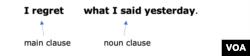
Other times, nosotros follow the words "I regret" with a noun clause. Y'all may remember that a clause is a office of a judgement with its ain field of study and verb. Substantive clauses act equally nouns.
Listen for the substantive clause in our adjacent case:
I regret what I said yesterday. It was non fair. I'thousand sad.
Did you lot find the noun clause? It was "what I said yesterday."
I wish (that)…
Side by side up is the phrase "I wish."
This phrase has a few uses in English language. When used to express regret, we are saying we experience deplorable that something was not different in the past. For instance, earlier I said, "I wish I had not hurried to paint the room."
As y'all hear this adjacent speaker utilise the phrase, make a mental note of the verb tense he uses.
I wish I had studied harder for the entrance exam.
Did you note the verb tense? It was by perfect and the verb was "had studied." When we use "I wish" to limited regret, the usual verb tense is the by perfect.
All the same, in spoken English, Americans sometimes apply the simple past tense instead, like this:
I wish I studied harder for the entrance exam.
It is also worth noting that noun clauses generally follow the verb "wish," just like in the entrance examination example and in my own argument near the paint project. You lot can larn more about noun clauses on earlier Everyday Grammar programs.
I should / shouldn't accept…
Our final phrase for today is "I should have." When someone uses this phrase, it means something did not happen merely we wish it had happened. For example, I said, "I should have tested the color kickoff."
Y'all may recollect that the verb "should" is a modal verb. The discussion "have" in the phrase is role of the present perfect verb tense. The one I used was "take tested."
At present, listen to this speaker using "I should accept" and take note of the verb:
I was belatedly for work today. I should accept woken upward earlier.
He used the present perfect verb "take woken up."
We can also use the negative grade -- "I should not have" -- to limited the same general ideas, like this:
I was late for piece of work today. I should non have slept so late.
At present, you lot endeavour it! Utilize one or two of the phrases from this program to talk about a regret or something you wish y'all had done differently.
I'chiliad Alice Bryant.
Alice Bryant wrote this story for VOA Learning English language. George Grow was the editor.
________________________________________________________________
Things Americans Say...
You might hear an American say something like this: "I wish I would accept studied harder for the entrance exam."
Technically, the structure "I wish I would take..." is non grammatically correct. The word "would" should non be used with the phrase "I wish" in formal English. However, in spoken American English, it is quite common and often considered acceptable.
________________________________________________________________
Words in This Story
drab – adj. non bright or colorful
disappointed – adj. feeling sad, unhappy, or displeased because something was not equally skilful as expected
phrase – n. a group of 2 or more than words that express an idea but do not unremarkably class a complete sentence
clause – n. a part of a sentence with its own subject and verb
verb tense – n. a class of a verb that is used to show when an action happened
modal verb - a verb (such equally tin can or should) that is used with some other verb to limited possibility, necessity or permission
negative – adj. expressing denial or refusal
Source: https://learningenglish.voanews.com/a/three-phrases-for-expressing-regret-in-english/5558739.html
0 Response to "Once Again I Express My Regrets That"
Post a Comment