Everything You Need to Know Social Recruiting
Note: We updated this blog with newly learned insights from 2021 and tips to set your social recruiting efforts upward for 2022.
Multiple generations of digital natives are in the workforce. Whether yous're looking to fill junior positions or find leaders for senior roles, yous need a strong social recruiting strategy to source talent from amidst today'southward candidates.
What is Social Recruiting?
Social recruiting is the process of advertising jobs, recruiting candidates and connecting with potential employees through social media platforms. Information technology is too commonly referred to as social hiring or social media recruiting.
Co-ordinate to a 2021 study past CareerArc, 92% of employers said they use social networks to find talent. In fact, for many companies, social is now the become-to option for finding candidates. Information technology basically ranks ahead of ads, employee referrals and fifty-fifty job boards.
How to use social media for recruitment
When you postal service a task on your company's social media page, you tin leverage your followers' and employees' networks to get the word out in just three steps:
- Yous share a new job posting on your visitor'due south social media folio.
- Your followers and employees share the mail with their networks.
- Your reach grows exponentially, making you more than likely to observe the perfect candidate.
Platforms for social media recruiting
When you lot remember of using social media for talent acquisition, LinkedIn probably comes to heed.
LinkedIn is a proven leader in social media hiring:
- 55 job applications are submitted every second.
- 50 one thousand thousand companies are listed.
- 2 million small businesses are using LinkedIn to hire employees.
- Over twenty meg open job listings are posted on LinkedIn Jobs.
But LinkedIn isn't the only option for recruiting via social media. Twitter, Facebook, and even Instagram have become pop social media recruiting sites.
Does social recruiting work?
Yes! Done correctly, social recruiting tin assistance your business identify, reach out to, and hire high-quality task candidates. In fact, the following social recruiting stats tell us that this strategy is a must-accept:
- 86% of task seekers say they use social media for their job search (CareerArc)
- 35% of respondents to a 2019 Jobvite survey said they acquire about new task openings through social media.
- 41% of younger respondents said they were near probable to use social media to look for new jobs
- 71% of hiring determination-makers said reviewing social media profiles is an effective way to screen task applicants (Express)
- Roughly 40 million people look for jobs using LinkedIn every week
- 78% of recruiters wait the utilise of social media for finding candidates will increase (Jobvite)
- lxxx% of employers say social recruiting helped them identify passive prospects (Betterteam)
- 70% of hiring managers said they hired candidates using social media (Betterteam)
- 84% of companies are currently using social media for recruiting (SHRM)
Social media use past companies, and specifically recruiters, has been on the rise for several years. A 2017 CareerArc written report institute that employers predicted social media marketing to be the most in-need Hr skill by 2020—and that trend has not slowed down.
Is social recruiting more effective than traditional recruiting?
Aye. While traditional recruiting styles are notwithstanding in use, social recruiting is more than effective in terms of generating reach and keeping costs low. You lot don't accept to pay on a cost-per-click basis for a single bidder (which tin can run upwards to thousands of dollars per posting in some cases).
Instead, yous only accept to focus on getting your job postings in front of the correct people through a potent social strategy.
Benefits of Social Recruiting
Why should you make social media part of your recruiting strategy?
Hither are iii big benefits of social recruiting.
1. Connect with more than candidates.
A passive candidate isn't actively looking for piece of work but is open up to new opportunities. Traditional recruiting strategies and job boards won't reach these potential employees—but they brand up 70% of the candidate puddle.
Social recruiting helps you get your job listings in front of candidates that yous wouldn't otherwise attain. Passive candidates might not exist scrolling through job boards, but they are scrolling through their social media feeds. This allows them to see your company'southward posts and decide if they'd be a good fit for your organization.
A passive candidate might stumble across your job listing on their feed. If they do use, it'll be because they call back it'southward a corking fit for them—non because they're desperate to exit their electric current role.
2. Save money and fourth dimension on hiring
In full general, information technology costs businesses over $4,000 to hire new talent. It takes forty-ii days on average to fill a given position.
Social media recruiting can salvage your visitor time and money. Sponsored postings on job boards are expensive—and y'all tin't guarantee that you lot'll reach candidates that fit your open function.
When y'all leverage your employees' networks and the power of give-and-take of mouth, you'll reach more potential recruits in less time and for less money.
iii. Showcase your employer brand
In 2017, 47% of job seekers pinpointed company culture as the master reason for wanting to exit their current company. Social media lets you share your company culture and values alongside your job postings—and gives potential candidates an inside await into life in your workspace.
To highlight your employer branding on social media, you can:
- Share employee-generated content (EGC).
- Inform your audition of company benefits and initiatives.
- Encourage employees to post on social and interact with interested parties.
(Bank check out 6 tips to leverage LinkedIn for your employer brand.)
7 Compelling Stats on Social Media Recruitment
These powerful statistics showcase the benefits of social media recruitment for building the all-time team, and how social media works to help you find top talent.
1. The Majority of Companies are Using Social Media for Recruitment Today
Surveys showed that at least 84% of organizations are currently using social media for recruitment and that 9% of those who don't yet use it are planning to. Organizations that don't want to be out-recruited past competitors or left behind should make sure they are likewise taking advantage of the trend. Developing social media guidelines is a great kickoff footstep to launching internal and external social media programs.
two. Social Media is Where Millennial Candidates are Looking for Jobs
A study from the Aberdeen Group revealed that millennials are irresolute social recruitment practices: 73 percent of millennials (18-34 age group) found their last position through a social media platform. So, if you desire to target the youngest and near motivated group in the workforce, make certain that you utilize platforms that appeal to them.
3. Social Media is Where People are Spending Time
Studies prove that people are spending A LOT of time on social media. In fact, if global social media usage continues to expect like what information technology does today, the average person will end upwardly spending more than than v years of their life on social media. For that reason, it's smart to recruit where people are spending their time.
4. People Utilise Social Media to Find Relevant Content
Social media is an excellent resources for people who want to discover branded content that is interesting to them. In fact, a study by Marketing Sherpa showed that at least 58% of U.Due south. consumers use social media to follow brands.
If someone finds your company (or the bachelor jobs at your visitor) via social media, they either sought your contour out or it appeared to them because they expressed interest in relevant/related topics or organizations. Therefore, if someone connects with yous for a potential job position via social media, information technology often means they are engaged in your branded content or chronicle to your company culture content making them stronger candidates.
5. Social Media is a Great Opportunity to Harness the Power of Word of Oral fissure Recruitment
Leverage employees to amplify messages further through employee advocacy and social referral programs. According to a survey from Monster, 65 pct of respondents would consider a new task opportunity if they heard about information technology through a personal connexion. Word of mouth promotion tends to be effective no matter how information technology happens. In fact, studies by Nielsen show that 92% of people volition trust recommendations that they go from friends and family over any other kind of marketing, promotion or advert.
6. Social Media is a Good Place to Find Passive Task Candidates
Sometimes, the best candidates are those not actively looking for a job. Peradventure they already accept a position (but could be wooed away) or mayhap they are just not seeking the type of chore you're offering. Despite not actively looking for a job, passive job candidates can often be the all-time fit for a position, and social media has proven to be a great place to find these candidates. A survey showed that 82% of organizations currently use social media in gild to successfully recruit passive job candidates.
7. You Can Still Get Alee With Social Recruiting.
While 84% of organizations are using social media for recruitment, the majority aren't actually employing a proper social strategy. According to a 2021 CareerArc written report, only 39% of employers target specific audiences (e.g. via hashtags). Moreover, only 39% of them involve their employees in sharing branded content.
Effective Social Recruiting Strategies
1. Empower employees to become involved.
Some of the all-time candidates come up through employee referrals.
Make it easy for your employees to share task openings and posts about visitor culture on networks they already use. If you take 100 employees, and each employee is sharing posts with 150 followers, you tin can reach up to 15,000 people through online employee advancement—and these followers are likely to be more engaged than those just post-obit your make.
Employee advancement programs are a swell way to get employees involved. An employee advocacy platform helps you centralize content such as job openings, event information, and company updates, so it's easy for employees to share information technology on personal social media profiles.
two. Optimize your social profiles for search.
Most candidates are passive, merely you should withal make your profiles and chore postings easy to discover for active job seekers. Ensure that your social profiles include keywords like your industry, location, and of course, the fact that you're hiring.
When yous share chore postings on social media, include the job title and location in the mail text (not just in a graphic or link preview). These details make it easier for candidates to discover you.
3. Know where your candidates spend time online.
In marketing, you need to meet your customers where they are. Recruiting is no unlike.
If y'all're looking to make full a design role, check out more visual platforms like Dribbble or Instagram. If you need to hire a software engineer, Github may be a better bet.
Practise some inquiry into where your platonic candidates practise most of their social media scrolling. One way to find out? Inquire your current employees which platforms they utilise the most.
four. Use advanced search features.
For a more than targeted approach, social media platforms take advanced search options that tin can assist you observe your platonic candidates.
Facebook's Graph Search lets y'all search profiles based on location, interests, pages liked, areas of study, and more. Graph Search is a great way to discover potential candidates if you're looking for local talent with specific education experience or interests.
You can also add job postings to Facebook. You need a Facebook business folio, merely you can make job openings appear under the jobs bookmark. This fashion, your employees can share those postings to their personal timelines. You tin can also accomplish targeted audiences using the paid boosts feature. This lets you target locations, piece of work experience, and education.
LinkedIn is the most business-oriented social network, so information technology makes sense that their advanced search is the well-nigh well-suited for finding candidates. LinkedIn'south advanced search makes it easy to find candidates with specific skills and experience. Using LinkedIn Recruiter, you can use avant-garde search filters, receive smart suggestions and integrate with your applicant tracking organization.
Twitter's advanced search feature is the most limited. If candidates and recruiters in your field use specific hashtags, you may be able to search that hashtag to find interested parties.
TikTok Resumes
In 2021, TikTok introduced TikTok Resumes. Through a pilot programme, information technology allows some companies to post job openings. Candidates can respond with short videos which basically human activity as resumes. Information technology's an unconventional approach, but it offers a lot of potential in reaching out to young prospects who are comfortable with using TikTok.
five Examples of Social Recruiting
Here are five existent-globe examples of social recruiting and displaying employer branding.
1. UPS Jobs

@UPSJobs features job postings and company culture content. UPS uses the hashtag #FutureYou in job posting tweets—and the page's Twitter bio reads, "Future You is a UPS employee." They engage followers by making them feel like a part of the squad and showing what it's like to work at UPS.
2. Inside Zappos
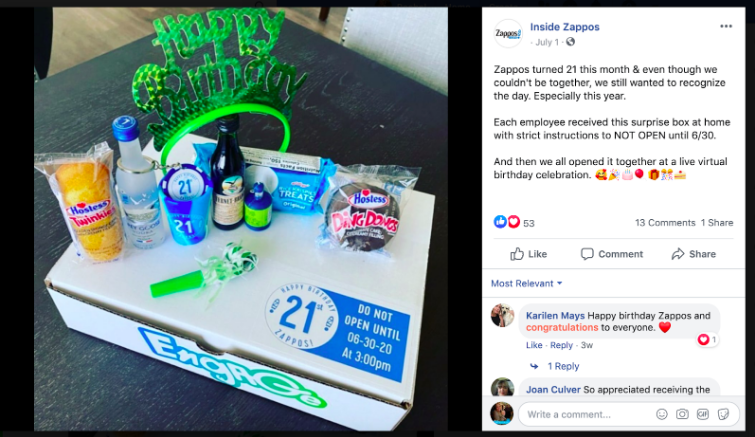
Zappos uses Inside Zappos to highlight company culture and celebrate employees. For example, the visitor'southward 21st birthday roughshod during a time when most employees were working from home to increment social distancing. Zappos sent each employee a surprise souvenir box with the instructions not to open until a virtual birthday celebration. Potential candidates see this and know that a fun visitor civilisation awaits them—even during a time when in-person activities are limited.
iii. ADP Careers

ADP uses its @ADPCareers Twitter and Instagram accounts to highlight employees and their accomplishments. Past letting employees share their experiences at ADP in their own words, the company gives chore seekers a more authentic, apparent look into what it's like to work with them.
4. Hilton Careers

Candidates want to work for companies that share their values. This mail service on Hilton'southward recruitment-focused Instagram account celebrates Women's History Month — and helps demonstrate that the company values female employees. Both Hilton'south official account and employees' posts employ the hashtag #WeAreHilton when sharing company culture content.
five. Spotify

Spotify's LinkedIn folio features employees from around the world in brusque, shareable video content. They highlight dissimilar departments and offices so that potential candidates get a well-rounded view of what it's like to exist a member of the Spotify team. Plus, Spotify's employer branding uses a fun, music-themed hashtag: #jointheband.
How to Build a Social Recruiting Process
Ready to make social recruiting part of your talent conquering strategy?
Hither are vii steps to building a stiff social recruiting strategy.
1. Set goals and metrics.
You won't know if your recruiting strategy works unless you set goals and benchmarks.
Do you want to increment the number of applicants? Shorten the hiring process? Achieve more than qualified candidates? Cull metrics that help you measure those goals, then look at how your current recruiting strategy measures up.
Some popular social recruiting KPIs include:
- Fourth dimension spent per bidder
- Toll per rent
- Social media appointment
- Employee referral rate
- Clicks from social media to your hiring page
- Offer acceptance rate
2. Know your ideal candidate.
When you know what feel, traits and skills make up the ideal candidate for a role, you tin can better target that type of person through social recruiting. Social recruiting is a great fashion to see if a candidate is a bully fit for your visitor culture because you tin can see how they live out their values and represent themselves online.
iii. Check out your competitors.
Do your competitors accept a potent social media presence? If so, are they using their accounts for recruiting?
Y'all don't demand to be everywhere that your competitors are. Just if they have quality date with their social recruiting posts, knowing where they post can assist you figure out what you're upwards against. On the other hand, if their social recruiting doesn't seem to get engagement, yous can acquire what not to do—or identify gaps where your posts will stand out.
4. Define your employer brand.
Before yous tin promote your employer make, you lot need to define it. Choose which traits and values you want potential candidates to see, then double-check that your social recruiting posts and employee-generated content reflect that.
Build your employer make from inside. Exist transparent with your employees about different initiatives beyond the company.
Some ways to increase transparency inside your workforce include:
- Internal newsletters
- Monthly boondocks halls with opportunities for employees to be heard
- Transparency involving salaries and benefits
- Honest conversations effectually diversity, equity and inclusion
- Special events and team edifice activities
- Volunteer efforts and social corporate responsibility initiatives
5. Choose the right social media platforms
You could post everything on every platform, but that isn't an efficient strategy. Figure out where your employees and ideal candidates spend their fourth dimension online, then choose the acme platforms for social media recruiting.
Choosing the correct social media platforms means choosing which kinds of content to prioritize. If yous programme to recruit via Instagram, you'll need to focus mainly on visual content. If your candidates are more than likely to exist on LinkedIn, curate a combination of text, images, videos and links.
6. Launch an employee advocacy program
Promoting company values and civilisation is fundamental to attracting summit talent. Creating an employee advocacy plan and leveraging your employees' networks can heave your employer brand and reach a wider audience.
1 great fashion to launch this type of program? Work with an employee advocacy platform like PostBeyond. Have y'all been considering starting an employee advancement program? Here'due south what you should know earlier you launch your program.
7. Measure, optimize, repeat
Regularly mensurate the results of your social media recruiting efforts. Review your social recruiting goals and make sure that they align with your broader company goals and hiring needs.
From in that location, you tin can adjust your strategy accordingly. Test new platforms and content until you figure out what works best to amend your target metrics.
Are Y'all Fix for Social Hiring?
Social media recruiting lets y'all showcase your company culture, achieve a larger talent pool and connect with your ideal candidates. As Gen Z and Millennials make upwardly more than and more of the workforce, social media will only become more valuable for recruiters.
Are your ideal candidates on social media? Then your recruiting efforts should be, too.
Source: https://www.postbeyond.com/blog/social-recruiting/
0 Response to "Everything You Need to Know Social Recruiting"
Post a Comment